 Health
 Identity
I’m Fine, Thank You
For 26 years, Carole told her neighbors she didn’t need anything. Then one of them stopped asking.
The recycling was the problem. Several bags of it, and the only way down from the second floor of the Culver City building was a narrow set of outside stairs.
Heidi Widmer heard it before she saw it. She had been in the apartment below since July, newly arrived from Buffalo with her dog and a middle-school teaching job eight minutes away, and for two weeks she had been listening to what sounded like a bowling league operating above her. She had a plan for that neighbor. She had recorded her own ceiling, narrating her complaint into her phone.
Then the neighbor came down the stairs. An 87-year-old British woman, shaking, carrying the bags. Two steps from the bottom she dropped them, and Widmer came out of her door.
“Oh my gosh, thank you,” the woman said. “Did you just move in? Am I too loud for you?”
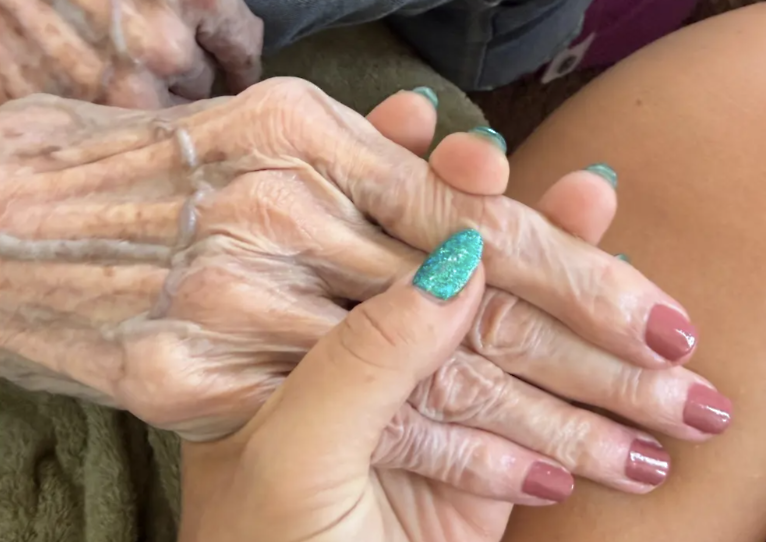
Her name is Carole. She has lived in that apartment for 26 years. She has had Parkinson’s since the early 2010s, and by 2019 the tremor had begun to change what she could do on her own.
The noise had been Carole hauling herself across her own floor to the mini fridge social services sent when her refrigerator broke.
Two days later, Widmer knocked. Carole opened the door partway and let her in.
“Carole, I will not judge you,” Widmer said. “I don’t care what this apartment looks like. I want to come in and take your damn trash out. And that’s it. You’re not asking for much. You’re not asking at all. I’m coming in and I’m doing it.”
Then she went in and did it.
The help Carole needed existed the whole time. Several people in her building had offered it. She had turned them all down.
Roughly one in four Americans 65 and older lives alone, about 26 percent, according to Pew Research Center’s analysis of census data. Most of them are managing, and would be insulted to be counted as anybody’s problem. The figure sharpens where age meets a failing body. Of the more than 16 million people aging by themselves, KFF Health News reports, close to four in ten live with a disability or with vision or hearing loss.
Carole is one of the sixteen million.
The fundraiser who never asked
Carole came to the United States from Birmingham, England, in the 1960s, when she was in her twenties. She says she did not get homesick. What she remembers is New York.
“I was so enthralled with New York,” she said. She stayed twelve years.
She worked as an au pair with families who moved and took her along, two years in Sweden, two in Palm Beach, eight months in Hawaii. She landed in Culver City and intends to stay there for the rest of her life.
Then she built a career asking strangers for money.
Carole raised funds for the Los Angeles Opera, the Art Institute of Chicago, Doctors Without Borders, the Monterey Bay Aquarium and the Philadelphia Museum of Art. She worked on the Linus Pauling exhibition at Caltech, and when it needed material she called the Art Institute, which sent the quantum physics posters that went on display. She has been a practicing Buddhist with Soka Gakkai International since the 1980s and raised money for that community too. The LA Opera emailed recently to thank her again.
She spent decades making the case for other people’s needs. Then she retired, the Parkinson’s progressed, and when others asked to meet her needs, she stopped them at her own front door.
Her neighbors were not indifferent. Several of them asked, more than once, whether she needed anything.
“My neighbors, lovely neighbors I have, and they all asked, ‘Can we help? Is there anything we can do for you?'” Carole said. “And I always said, ‘I’m fine. Thank you.'”
Widmer never asked.
“She didn’t say, ‘Can I help you,’ or anything,” Carole said. “She just came to my apartment and started helping me.”
Carole knows exactly what the years before that were.
“It’s very hard to explain. You need help. In your mind, you know you need help. But you don’t want to ask for it.”
The number that matters in this story is smaller. It is the number of people in one building who asked a polite question and accepted a polite answer.

“She wouldn’t let me in”
Carole was not alone in the way the internet assumed. She says she has never experienced loneliness or depression, and she credits her Buddhist community for that. She still goes to meetings. She chants for other people, for their illnesses and their finances. Years ago she wrote on a card that she wanted her apartment renovated.
One of the people in that community is a nurse. She had known Carole for years.
When Widmer learned this, she asked the obvious question. Why had Carole never been connected to care?
“She wouldn’t let me in her apartment,” the nurse told her. “You don’t think I tried?”
The resource was not missing. It was a qualified medical professional who attended the same meetings, who had tried for years, and who could not get through the door.
Pride is part of what stood in the way. Fear is the other part. Writing in Business Insider, Widmer put it plainly: Carole does not like accepting help from people, “especially social services,” and is frightened of the very people meant to help her.
That changes what the problem is. Carole was already receiving Social Security, SNAP and Medicaid when Widmer met her. She had been eligible for more help than she was getting, and she had been eligible for years.
She is not unusual. The National Council on Aging estimates that roughly $58 billion in benefits goes unclaimed by older adults every year. That money is appropriated. The programs are staffed. It sits there because eligibility is not enrollment. Someone still has to start the process, sit with the forms, answer the questions about what they can no longer do alone. That is reasonable enough as a way to run a benefit, and it leaves a gap that no benefit covers: the distance between a person’s door and the application. Carole had a nurse in her own community and a building full of neighbors who had offered. What she did not have was anyone whose job it was to notice, and a system that waits to be approached will wait a long time for someone like her.
She had a broken quality of life inside a working set of benefits, and a mini fridge where a refrigerator should have been.
Eighteen million views
Widmer had been posting about her move to Los Angeles. In August, Carole became part of what she posted. The clips traveled. The one that went furthest shows Carole, in the first weeks, telling Widmer she feels as though the two of them knew each other in another lifetime, as sisters. Widmer started crying and the camera caught it. 18.2 million views. Her following passed 340,000.
Thousands of strangers asked the same question. How do we help. The two of them put together a public wish list, and people started buying from it: a lightweight vacuum, and a butsudan, the Buddhist altar Carole had never expected anyone to buy her. A fundraiser for her care has taken in about $80,000 from more than 2,000 donors. More than sixty birthday cards arrived from Italy, Portugal, Ireland, Australia and England, and she answered every one by hand. The ones from England brought back foods she had forgotten.
The building moved as well. Widmer had been calling the landlord about the apartment, and after the videos spread he replaced the refrigerator, the stove and the carpet, and put in air conditioning.
Sitting with the forms
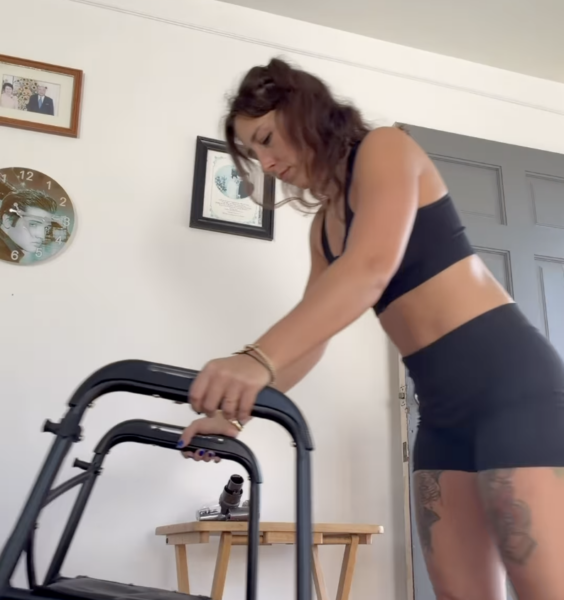
What Widmer did next was not dramatic. She took the trash out twice a week. She cooked, because Carole had been living on microwave meals. She kept showing up until the conversation could turn practical.
She asked whether Carole’s coverage paid for help at home, and told her what she thought it should look like. She did not mind coming up for an hour a day. Carole could have someone making her meals instead, and sit down while they did it.
It took weeks of that conversation. This autumn the application went in, and Carole was approved for regular in-home help with meals, light cleaning and keeping the apartment up.
Widmer is clear that the approved hours overshoot what Carole needs, and clearer still about what Carole can do for herself.
“Carole can take care of herself. She truly can. She is able. She shakes, but she can take care of herself down to her physical and health needs. It’s keeping up with her living environment that’s difficult, because she shakes.”
Food drops on the floor when she cooks, and an 87-year-old with tremors cannot easily retrieve it. The vacuum that arrived from her wish list is a light one, and she uses it nearly every day and calls it good exercise.
A stair lift is being installed this month, paid for out of the fundraiser rather than by the building. Carole will use it rather than move. People online keep suggesting the two women swap apartments so she does not have to take the stairs at all.
“You try convincing an 86-year-old woman who’s been in this place for 26 years that she needs to move,” Widmer told People. “I haven’t been able to talk her into it.”
The renovation Carole wrote on a card years ago arrived. She considers that a matter of practice, not luck.
Granddaughter, grandmother
The story travels as a story about rescue, and both women push against that.
Widmer was raised Catholic and calls herself a people pleaser to a fault, and Carole has spent two months teaching her to say no. Carole also does not believe in anger. She thinks it should be turned into a joke, on the grounds that anger does not reach the person it is aimed at and goes to work on your own health instead. Widmer says that is the hardest lesson she has been given and the one she needed most.
“I might be helping her, but she is helping me so much more, and people don’t necessarily see that,” Widmer said. “They just see me as the helper, and I’m like, you’re not getting the whole picture.”
They text every day and see each other most days. Carole calls her granddaughter. Widmer calls her grandmother, having been corrected once for trying grandma.
There is comedy in the apartment. Someone sent letter openers for the birthday mail, and Carole could not get the letter openers out of their packaging. She found this funnier than anyone.
Carole did not want to be interviewed at first. What changed her mind was an argument about other people. Widmer asked her to consider how many of them are living the way she had been, too proud to accept help, and what it might do for them to watch someone her age say yes.
The ripples they’re creating
In November, Widmer put a question to her followers. Tell me how you are checking on your neighbors. Within a day the post had drawn more than three hundred replies, and she says the messages arriving in her inbox now run into the hundreds, possibly higher.
Most of the replies came from people who have been doing this quietly for years and had never thought to call it anything. The ones that matter for the argument are the others.
One woman wrote that she had seen Widmer’s post about not asking, just helping, and that later the same day she watched an older woman struggle with a load of bags into a cab while the driver sat there. She got out and helped. Another follower told Widmer she had pulled a neighbor’s bins out to the yard after watching her fight with them. A third started bringing meals.
Widmer is now asking people to send photographs, the bins, the plate, the driveway, so the acts have evidence attached, and she plans to put pins in a physical map of where they happen. The Instagram hashtag she uses is #checkonyourneighbors.
Learning to drive in high school, she saw an older woman stranded partway across a bad intersection, panicking about the light, and parked her car in the middle of the road to walk her across. It’s the same logic as when she met Carole on the stairs.
“You just don’t ask,” she said. “You just do. You just step into action if somebody needs help.”
Assigned to notice
None of this has to be invented. The models exist, and they are unglamorous.
A Meals on Wheels route is the clearest one. The network reaches 2.6 million older adults with 244 million meals a year through about 5,000 local providers, and the meal is not the whole point. By the network’s own count, 97 percent of providers train their drivers to watch for a client’s well-being and 89 percent train them to watch for safety problems around the home. That is a system that has already solved the hard part. Somebody is assigned to notice, on a schedule, and they are taught what to look for.
The village movement does it with neighbors instead of staff. Villages are membership groups, mostly volunteer-run, that organize rides, repairs and visits so older people can stay in their homes. The first opened in Boston’s Beacon Hill in the early 2000s, and hundreds now operate nationally through the Village to Village Network.
Smaller versions keep appearing on their own. One woman wrote to Widmer about a group her sister started after their parents died, now twenty-odd women who host lunches for nursing home residents nobody visits. Four years running.
What each has in common is the thing Carole’s building lacked. The job of noticing belongs to a named person, not to everyone in general. What arrived for Carole was a teacher who moved in downstairs and would not take a polite answer.
A kind of arrogance
Asked what she would tell other people after this year, Carole did not talk about kindness first. She went after her own position.
“Apparently you should accept when somebody is asking you if they can help you,” she said. “In fact, it is a kind of arrogance on my part to not accept help.”
That is a hard sentence from a woman who spent her career making other people’s cases.
There is a version of friendship that treats being needed as a gift rather than an imposition. Being allowed to show up is the part the helper gets. Saying no to an offer takes that away from both people.
Carole lives upstairs, in the apartment she has had for 26 years, with new carpet and a stair lift and someone coming to help with the meals. She still goes to her meetings. She still answers her mail. And somebody downstairs finally stopped asking and started doing.
HOW YOU CAN CREATE IMPACT:

5 MINUTES: Do the thing instead of offering it. If an older neighbor struggles with their bins, take the bins out on collection night and say nothing about it afterward. Then write your name, unit number and phone number on a card, put it under their door, and name the one thing you will handle from now on. Then tell Heidi. Send a note and a photo of what you did to @omgitsheidiii, the bins at the curb, the plate on the step. She is collecting them and putting pins in a map.

5 DOLLARS: Support Parkinson’s programs where you live. In Los Angeles, Parkinson’s Community Los Angeles (pcla.org) runs support groups and programs for people with Parkinson’s and their caregivers.

5 DAYS: Make the call your neighbor will not make, then stay for the paperwork. The federal Eldercare Locator, 1-800-677-1116 or eldercare.acl.gov, routes any zip code to the local Area Agency on Aging, which handles meals, transportation and in-home help. Sit at their kitchen table and fill out the application together. That intake form is where most people stop, and it is the single most useful afternoon you can give. Or take one delivery shift with your local Meals on Wheels provider. Every stop on the route is a daily check on somebody who lives alone.





 Land