 Health
Dieting is a Social Illness. Youth Pay the Price


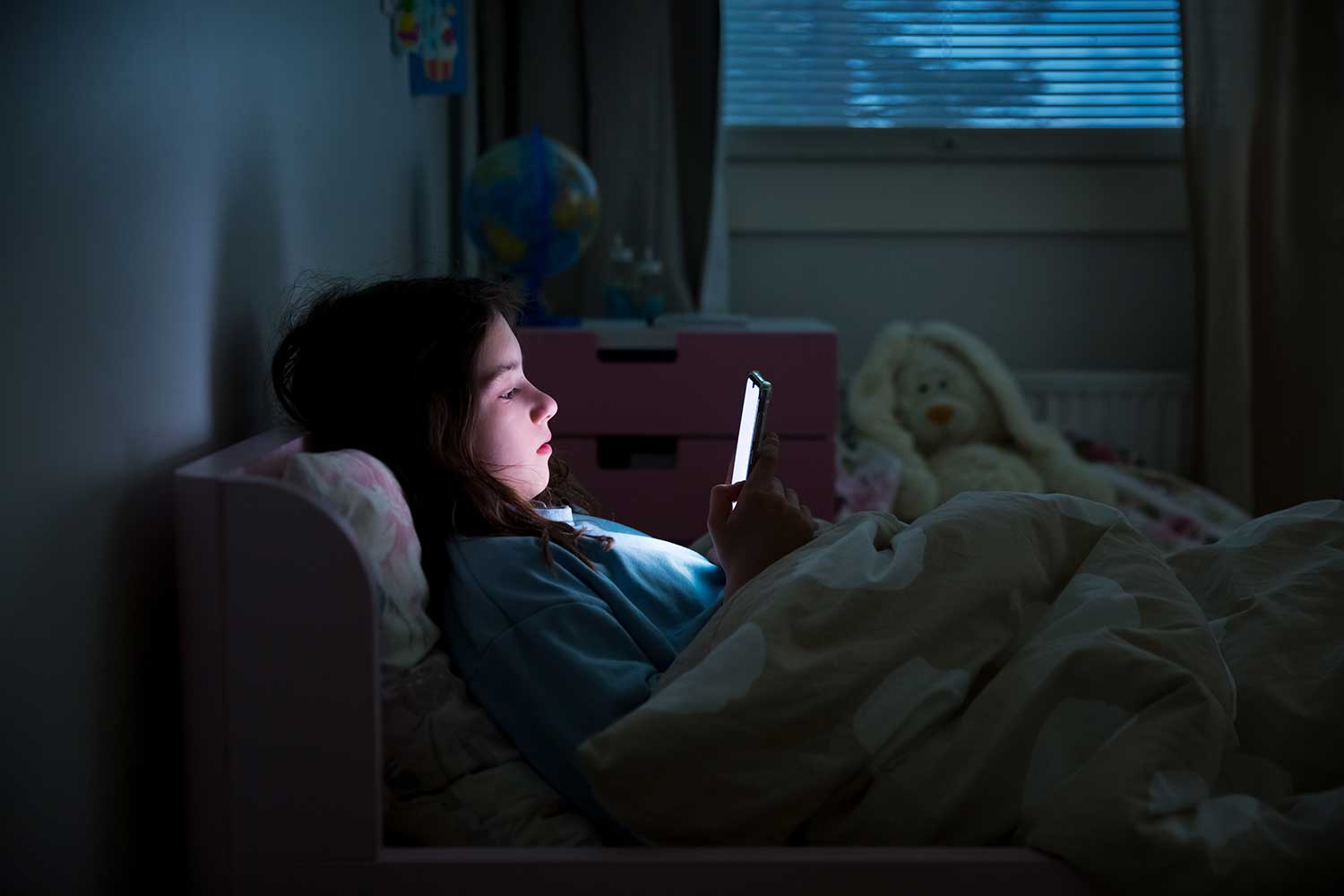
On social media, you tend to see the same kinds of bodies over and over, and it’s easy to feel like that’s what you’re supposed to look like. The thing is, I didn’t even really know what an eating disorder was, so it kind of just happened without me realizing it would become a bigger problem. I wish someone explained earlier how serious it is, and maybe normalized that your body is supposed to change as you grow up.
I recently sat down with a 19-year-old in recovery for an eating disorder. Her experience and observations were so striking, I wanted to share with a wider audience.
In her own words:
“My family didn’t have eating issues or anything, but there were definitely little jokes or comments about weight at home. I never really thought about my body until I started high school. Then during COVID I gained some weight, and a few summers later I got into a new eating routine and lost more than I gained.
People my age are losing the ability to think for themselves and think critically, or to question the information they’re hearing and seeing online, or getting from AI.
Younger consumers are putting too much faith in online influencers and are far more susceptible to falling for anything online. And the apps come up with something new every day. Today it’s, ‘What kind of animal-pretty are you, bunny-pretty or deer-pretty?’ Tomorrow it will be something else just as shallow, but these simple games are addictive.”
Her reflection on the ecosystem shaping standards of beauty names what many parents feel but struggle to articulate, or cannot see. We are raising children inside a hyper-technical appearance economy where identity is sorted, labeled, gamified, and monetized at algorithmic speed.
Body types can’t be prescribed; but for them, thinness or being “chiseled,” feels like a moral imperative. Marketed as self-discipline, diet culture is a social illness disguised as wellness and morality.
A New Mindset to Move Forward
Heading into May, Mental Health Month, means #NoDietDay will appear in our algorithms on May 06 and encourage us to reject diet culture for 24 hours. This year, I invite you to go one step further.
Teens in the 80s and 90s who reached puberty and gained body fat for the first time, began to rethink their identity while turning pages of Seventeen magazine or Sports Illustrated. With Weight Watchers ads circulating everywhere and cover shots giving Linda Evangelista, Kate Moss, or Arnold Schwarzenegger vibes, all we had to do was put the magazine down. In comparison, we had it easy.
I say “easy” facetiously of course. It was nothing of the sort for vulnerable young minds like my own. And while celebrity magazines had their place in dopamine delivery, we didn’t receive hourly updates from them, manipulating us to want more.
Today’s youth have it harder, weighted down in weight-loss content and influencers who chronicle their shrinking or looksmaxxing in real time. Comment sections applaud “discipline.” Algorithms amplify before-and-afters as if they are public service announcements. And for their parents, GLP-1 medications dominate the newsfeed.
Meanwhile, more regulated Canadian media spaces are attracted by big pharma advertiser budgets. Think big billboards at major intersections, with messages promoting weight loss for all to see. So when adults frame optimal health as an individual’s moral obligation, our judgment often jades us, and the kids are not all right.
This is healthism, pervasive peer pressure in which dieting functions as an infected form of moral obligation.
We Are Living in a Paradox
When we treat weight as the problem without addressing weight stigma, we are not managing systems that perpetuate it.
On one end of the spectrum there is obesity: a complex, chronic condition influenced by genetics, environment, trauma, access to food, and socioeconomic factors. Ob*sity (asterisk intended to imply the frequent misuse of obesity as a dirty word) is not a moral failing, and yet the numbers recorded at clinics create biases that are absorbed far beyond the waiting room. Even the initial screening tool for obesity remains BMI, a blunt instrument that does not distinguish muscle from fat, athlete from sedentary, or health from health risk.
On the other end of the spectrum is restriction and starvation: disordered eating sometimes influenced by messages from an adult world inadvertently telling children to avoid fatness at any cost. As a reflection of how early kids begin forming beliefs about their worth based on appearance, a joint report by the BC Ministry of Education and BC Children’s Hospital cites that “being fat is more frightening to some girls than cancer, nuclear war or even losing their parents.”¹
This fear is amplified by micro-criticisms or bullying from others, and, worst case scenario, bullying of oneself. My own relentlessly cruel inner voice first showed up at nine years old. Her belligerent whisper became a roar so loud that by thirteen I ignored my body’s need for sustenance, believing I would be more acceptable to the adults in charge if I weren’t so fat.
This bully has a name: atypical anorexia, a condition more common than anorexia nervosa but much harder to see.
When Bodies Become Moral Measures
Weight-loss trends and high-volume pharmaceutical interventions cannot be considered in isolation. They operate within a society that constantly signals which bodies are “acceptable” and which are not, long before anyone ever steps into a clinic.
Although not all eating disorders are created equal, the vast majority involve some form of food control, restriction, or rigid rules.
Did you know that eating disorders carry the second-highest mortality rate of any psychiatric illness? And yet, the Canadian healthcare system is not currently equipped to deliver early interventions. It is estimated that only 25 percent of those lost in the struggle will seek treatment. Meanwhile, over three-quarters of eating disorders begin in childhood, and pediatric hospitalizations surged across Canada after the pandemic, including among pre-pubescent children. According to the Canadian Institutes of Health Research, an estimated 1.4 million Canadian youth are affected. And the most current systematic review reports that during the period 1999-2022, the global overall proportion of children and adolescents with disordered eating was 22%.2
Why not seek treatment? Big scary words like “psychiatry” and “mental illness” tend to ward off those of us who have managed to quietly survive an eating disorder, sometimes unknowingly until after the fact, or until we relapse later in life.
These illnesses are not simply private psychological conditions. Many are incubated and amplified by a culture that moralizes bodies by type and size, and disguises restriction as health.
Where Prevention Begins
Between the extremes of severe obesity and life-threatening starvation, countless young people are learning to distrust their bodies.
Some are naturally thin and sedentary, praised even if their cardiovascular health is ignored. Others are athletes labeled obese by BMI charts. Others inherit genetic predispositions toward higher weight and internalize the message that their body is a problem to solve. Many will struggle in silence because they don’t look unwell. They mask their pain.
This is where prevention becomes practical. It often starts in ordinary, repeatable moments. It looks like adults modeling a neutral relationship with food instead of labeling it “good” or “bad.” It looks like coaches and teachers prioritizing strength, energy, and skill over appearance. It looks like helping young people question what they see online, asking who benefits from the message and what might be missing. These are small shifts, but they accumulate. When kids are given language to understand their bodies, space to trust their hunger and fullness cues, and examples of adults who value themselves beyond appearance, they begin to build a different baseline. One where their body is not a problem to solve, but something to live in and care for.
The kinds of eating disorders that can lead to dangerous outcomes begin quietly, with food rules, body checking, fear of judgment or loss of control. With a casual family comment. With an influencer’s transformation or a well-meaning diet.
The Canadian Eating Disorders Strategy acknowledges that eating disorder prevention remains underfunded and often overshadowed by obesity-focused initiatives, even though weight-centric messaging can unintentionally fuel the life-threatening illnesses we should be preventing.
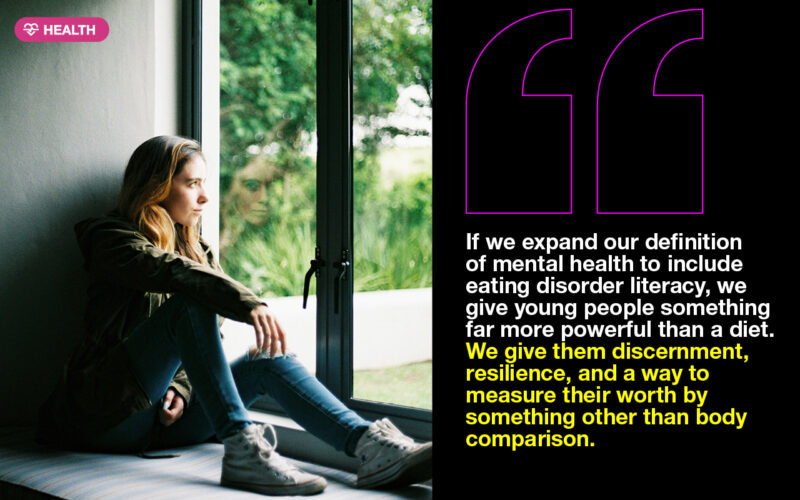
If we expand our definition of mental health to include eating disorder literacy, we give young people something far more powerful than a diet. We give them discernment, resilience, and a way to measure their worth by something other than body comparison.
Eating disorder literacy must be part of the mental health awareness conversation. Our children are consuming weight-loss messaging without guardrails.
HOW YOU CAN MAKE AN IMPACT:

ACT: Catch one thing you say about bodies this week, whether it’s a comment at dinner, a joke about someone’s plate, or a remark about your own reflection. When you catch it, swap it for something that has nothing to do with how anyone looks.
ADVOCATE: Over three-quarters of eating disorders begin quietly in childhood. Ask your school to bring NEDIC‘s virtual* student workshops into their classrooms. *Workshops are available on-site for GTA residents.

LISTEN: Tune into a podcast that reframes how you think about bodies and food. Rethinking Wellness with Christy Harrison unpacks diet culture, weight stigma, and wellness misinformation. Subscribe to the companion Substack for written deep-dives between episodes.
MOVE: Find a body-affirming way to move your body. Body-affirming movement is about how you feel, not what you’re burning off. Barre Eclipse, a fitness community built as a deliberate refuge from diet and fitness culture, is a good place to start.

SUPPORT organizations like Reframe Voices, a BC nonprofit founded last year that works to prevent eating disorders by equipping parents and caregivers with practical tools and increasing awareness of early signs of disordered eating at home, beyond the school setting.
JOIN: Recommend the BeaYOUtiful Foundation to the young girls and non-binary youth in your life. Their in-person and online programs for ages 8–14 focus on self-worth and body image. If you want to go further, they welcome volunteers and sponsors too.
Penny Greening is the founder of Reframe Voices, a BC nonprofit on a mission to educate parents on how to get ahead of “the monster” that is an eating disorder before puberty and early adolescence dials up the risk.
Follow @ReframeVoices on Instagram, TikTok, YouTube or LinkedIn.
- D. Mogensun and L. Yiu, Understanding Eating Disorders in BC Schools: A Guide of Trauma-Informed Practices for School Professionals (Kelowna: Kelty Eating Disorders Resource Centre, 2016), https://keltyeatingdisorders.ca/wp-content/uploads/2016/06/Understanding-Eating-Disorders-in-Schools.pdf
- Pastore M, Indrio F, Bali D…, Alarming Increase of Eating Disorders in Children and Adolescents, The Journal of Pediatrics, 2023; 263,
https://www.jpeds.com/article/S0022-3476(23)00596-6/fulltext

 Identity